While I’m a big fan of card games, the roguelike sub-section of the genre hasn’t captured my interest as much as CCGs and auto-battlers. I’ve tried Slay The Spire and some of it’s adjacent clones, but they always fell short of the gameplay experience that I enjoy. The Simulacrum, however, has crushed what I thought a roguelike card game is and could be.
The Trinity
The Simulacrum is a deckbuilding roguelike in which all cards are procedurally generated. The actual gameplay itself is pretty much a mtg-like, sacrifice cards in hands to generate a mana pool to play cards onto a board with 7 spaces. Units automatically attack left from right, as well as start and end of turn abilities. There’s three gameplay modes, Battle AI, Bosses, and Delve. These three modes creates a simple, but challenging gameplay loop. In Delve, you pick a leader to face off against a prototypical roguelike track, starting with a deck of new procedurally generated cards. When you defeat a track’s boss your current deck is added to your collection. This ties into Battle AI and Bosses in a major way. The Battle AI has 25 levels of difficulty, you’ll need the cards you’ve accumulated from Delves to build decks, to take down the AI. By playing the game you’ll unlock bosses, which when beaten will allow you to pick them as a leader in the Delve mode and play in constructed. Bosses also is a constructed mode in which you’ll need to a build deck to defeat them. If you can’t seem to unlock a boss that you want to play, there’s a hint section in the store that you can sink money into.
The Brilliancy
The dynamic of building your own personal one of a kind collection is something that keeps me playing. The prompts of the generated cards can make some wacky and fun stuff, it never gets old finding or upgrading cards(in delve there’s events that upgrades cards). It’s a wonderful experience for anyone that enjoys deck building in CCGs. My favorite thus far has been playing a resurrect deck where you can cheat out any unit from the deck by turn 2. Against the highest Battle AI, that’s still not strong enough win the game more often than not. It’s a challenge that I love taking part in, constantly figuring out the right ratio and play patterns to win. Of the currently 17 leaders the game has, each brings an unique and fun gameplay style. Anyone that has previously played card games will quickly find that their preferred play style is well represented in The Simulacrum.
Turn 3 combo fun.
Flaws
There’s not too much of anything that impairs my enjoyment for the game. The relics in delve mode from what I’ve experienced are very unbalanced. They turn many builds that would be decent/good to broken and unlosable. For some people the procedural generated cards may just not be enjoyable and may just want to stick to handcrafted card pools.
Future
The Simulacrum is in early access and is steadily adding content. There’s still color alignments that don’t have leaders at the moment. I still haven’t played against a friend yet and don’t plan to, the PVE aspect has my full attention. I’d be interested in a sort of draft mode that could be played with friends though.
With the release of Mythgard’s Rings of Immortality incoming, I got the privilege of participating in the q-mode testing. One archetype in particular has grasped most of my time, Omen Control.
The Core
As the name implies, Omen Control is a deck built around the use of Omen cards. Garland Arbor is the essential Omen that ties the package together, gaining 4 life and the ability to find more of your cards Omen has been proven to be strong. Naturally I went for Fires of Creation for the Path to use forgelings to find our artifact. The next card that must be played is Annulus Fabricator, the essential value card of the archetype. It’s not the most tempo effective card since it can’t copy on play and you need a fair amount of mana, but the value late-game is incredible and makes it hard to lose when it gets going. Filling out, I went with the core Yellow control tools such as Orbital Jamming Satellite, Misanthropia, Zolea, and etc.
Omens are very happy to have the Yellow tools.
2nd(and 3rd?) Faction
I’m still figuring out what the best option to pair the core Omens with. This is more of a good thing rather than bad, since from my testing all of them felt good. I came up with 5 variants with 1 being dual color. I’ll show off all them, but I’ll highlight the BOY variant the most. The one constant with all the tri-color variants of the archetype has been Blue. Blue has a high amount of strong 2 gem cards that fits very well and is easy to play. As a mana hungry archetype, having access to Norden Datacore is incredible tool for us to get to our high level winning plays. New tools like Bragi’s Ballad allow us to dig deep into our deck and you can’t forget the Blue’s Omen Hall of Matrimony. Finally Allfather’s Horn gives the deck a strong wincon.
Blue a core part of Omen’s tri-color variants.
The Final Piece
I’ve liked the feel of Orange the most of all the pairs I’ve tried so far. It’s hard to argue against the best card in the game(Armageddon Angel) and the new tools. Jaza’Eri and Triennial Patrol fits and synergizes well with the deck keeping multiple minions on the board for Ollama Ring. Dark Passenger is one of the better ways to remove minions and the Orange’s Omen Adorner of Fertility is good cheap body with a high upside ring.
It’s exciting times with the first Mythgard expansion releasing. Lots of new archetypes and tournaments looming looks to finish Mythgard strong after a shaky first half of the year. I’ll be rolling giveaways here of Rings of Immortality packs so comment down below what you’re most excited for in the expansion and your Discord tag so I can contact you. Also the friends at KG has some takes on Omens so check those out as well: #1 and #2.
Beta Season II’s end is hastily approaching, so I wanted to write a sort of retrospective on it. Coming into Beta Season II I knew that decks like RO Midrange, Aztec Control, and YG Abomination where the most refined archetypes for ladder, though I wanted to test some of the lesser archetypes. The ones I settled and actually climbed with was YB Horn OTK, RG Control, and Rainbow Rush. The unforeseen archetype at the time that broke the meta was GB Necromantic which I’ll be sure to recount about. The list I’ll post here aren’t exactly up to date since I hit Champion January 19th, they’re supposed to help visualize the meta at the time.
Early Beta Season II Climb
The meta was pretty much how I thought it would be except for the huge amount of decks utilizing Allfather’s Horn. NKL came up with a sweet YB Horn OTK that felt decent enough against all the 3 best decks and just the fact the deck was interesting I naturally gravitated towards it. A big thing to note about early Beta Season II was the harsh points system that could give you as low as +10.0 RP in wins and -50.0 RP in losses, making the ladder more grindy than usual.
Assemble Twin tokens, Tailroot Wurm on Demolition Speedway, and Allfather’s Horn who knows what’ll happen. Deck:https://mythgardhub.com/deck?id=1218
The Horn OTK got me to M04, but the rise of GB Necromantic and other Necromantic variants ultimately had me drop the list. The matchup was pretty bad as Smite would tear down my life total faster than mend could protect it and my board clears sucked against them. Their OTK was faster than mine and more efficient on average. The matchups against the other top decks except for Aztec Control was also unfavored, so I was even more inclined to switch decks.
RG Control did really well during the time of the testing of December 2019’s tier list, so I wanted to give it a shot in the ranked environment. The switch was crazy good, peaking at M09, the matchup against YG was bad, but GB Necromantic kept the deck in check and underrepresented. The cycling was incredible with the deck, while having a really good early game for a control deck. No deck felt like a bad matchup, but then why did I switch at the last moment? Eventually most people at high RP switched to RO midrange which is an unfavored matchup and being in the hand of the best players didn’t give a lot of confidence with finishing the climb with RG. The GB Necromantic matchup was 50/50 ish as well, making the decision easier.
The end was a lot faster with the speed of Rainbow Rush. I was bigger on the deck than most, even with the nerf phobia around. It didn’t take me long to refine a list to my liking. The biggest changes were putting in generic good Norden and Oberos cards, like Shopworn Bull, Kara Morningwives, Magmataur, getting rid of Fire Eater obviously and going down on enchantments. The deck feelt good against anything, just Wonder Drug and Lavish Proxy could be hard to deal with. Punishing greedy decks was great and the RO and Necromantic matchups felt good since you were just faster than them. I ended up being the 5th person to hit champion this season which I was happy with, and I was also proud of how many different ways I adjusted against the meta.
Expect another tier list when Set 2 gets released, in the meantime I’ll do at least 1 deck tech article and 1 deck tech video when the march balance patch hits in a week or so. I may do a The Climb: Beta Season I if people would want that as well, not sure if people are interested in my thought process on my climbs. It was a few months ago, but knowing history on the climb could help the process of becoming a better player. May do a theorycraft video or article of the sort if we get set 2 spoilers in advance, which is probably likely, so look forward to that as well. Also check out my stream if you want to see some live content as well. Thanks for everyone that took out the time to read this thus far, have a good one wherever you are!
The Mythgard meta-game has a variety of decks that are competitive; I enlisted the help of a few champion level players on their insight on the meta and with play testing to form a proper diagram of how decks are positioned at the moment.
RO Midrange is a powerful and well rounded deck that can adapt to most situations. The deck aims to gain control of the board early with Shadavar Beast and efficient plays, then uses that tempo to get chip damage in eventually finishing off the game with rush minions and Ignitions. In most matchups you want to try your best to position yourself as the aggressor so your opponent is forced to block or trade into your minions, and you are free to use your rushers on their face. Due to RO’s incredible flexibility it ends up having a favorable matchup versus most decks, but it can sometimes struggle against the fastest aggro decks or closing the game through Wonder Drug.
Traditionally RO ran Stairway to Hades and To Heaven and Back along with Panic Raider for a late game value engine, but with the nerf to Panic Raider that plan became a lot more risky. The list featured here opts for a Green splash instead to gain access to Fated Firebird and Pseudonomicon, along with wake the bones for some added utility. – NKL
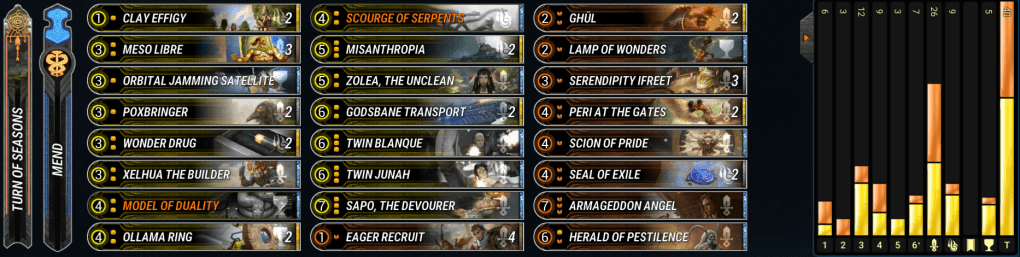
Aztec Control or better known as YO control is value deck that controls the board with mythic bombs and artifacts. The Trinity of this deck is the Misanthropia, Armageddon Angel, and Wonder Drug; the former are the two most efficient board clears in Mythgard and Drug is the best life gain card in the game. Having those in your back pocket allows you to regain tempo after playing your artifacts. This deck wins the battle of attrition by opting to use Mend; Impel isn’t needed as much in this control variant as big sturdy minions are able to lock down lanes and stay on board easily. Supporting stall tools like Meso Libre, Zolea, and Scourge of Serpents will also help getting you to the late game to play your threats.
Even with all the tools to slow the game down Aztec Control can still be tempoed down by decks. Still, the deck is positioned well in that the longer the game goes the more likely it is to win, and it goes long most of the time. – Oneiric
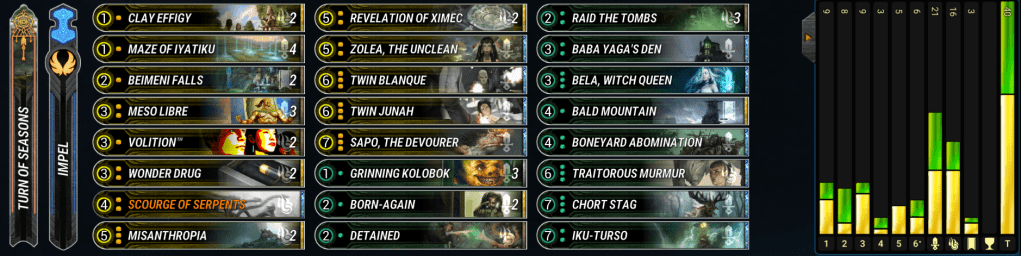
No, YG didn’t die with the multiple nerfs thrown at it, but it did have to adapt. YG can’t just rely on its one turn kill to win the game any more, now it is forced to actually interact with the board. The YG of today plays more like a traditional Yellow control deck that just happens to play Boneyard Abomination + Volition x2. You stall out the game with Yellow’s anti-aggro tools, then proceed drop bombs until one of them sticks, potentially allowing you to Volition it for massive burst. The buffed Scourge of Serpents helps a ton for this and every Yellow control deck to swing the board against aggro, sometimes winning the game by itself.
YG Control performs well against most aggro decks, all but the greediest midrange decks, and with the Abom combo in your back pocket it should be favored against other control decks if you make it to the late game. – NKL
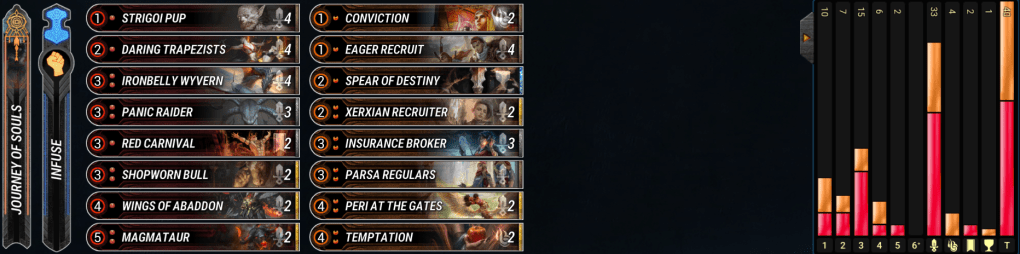
RO aggro is a sophisticated face deck, it abuses the journey path with a collection of thirteen rush minions. Even with getting a steady amount of card tempo from journey it stills uses powerful tools, like Peri, Shopworn Bull, and Insurance Broker to make sure you’re never out of gas. Magmataur in the mid game clears up blockers to continue allowing your minions to hit face, even then if you don’t draw a Magmataur, Conviction will help allowing that damage in. Eventually you’ll get to a point where Temptation or Red Carnival can finish the opponent.
The deck can have a hard time against cards like Shadhavar Beast and Master of Shadows clogging three lanes. Beimini Falls and Wonder Drug are looming threats as well with how much they heal your opponent through the course of a game. Overall the state of RO aggro is good if you are patient enough to learn the deck. – Oneiric Additional Tech@https://minmaxer.wixsite.com/mindfreak/post/deck-tech-ro-aggro
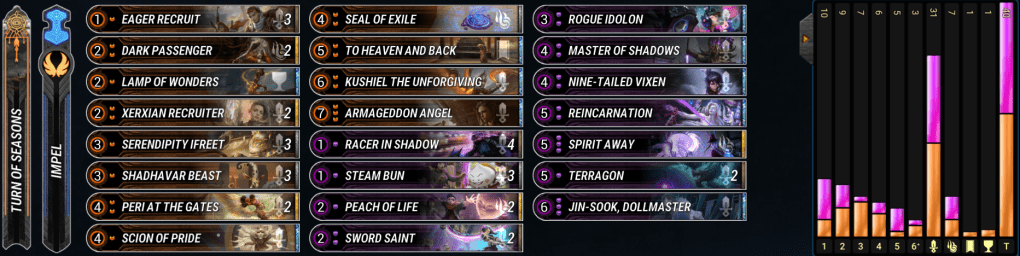
OP Control is a very grindy deck that runs an abundance of low cost cards, which can lead to a ton a decision points in any given turn. In a lot of ways it plays similarly to RO Midrange with its great board control, but unlike RO it lacks the rush damage to finish games quickly. However, what purple does offer is a much safer aggro matchup with Peach of Life and Sword Saint, along with some neat tools like Rogue Idolon, Master of Shadows, Reincarnation, and Terragon.
OP Control has a good matchup against most aggro and midrange decks, but can struggle against YO and YG. Before last patch RB Rush was a little too fast for OP to utilize peach, but with the nerfs to RB, along with the additions of Shadavar Beast and Master of Shadows, OP Control is a force to be reckoned with once again. – NKL
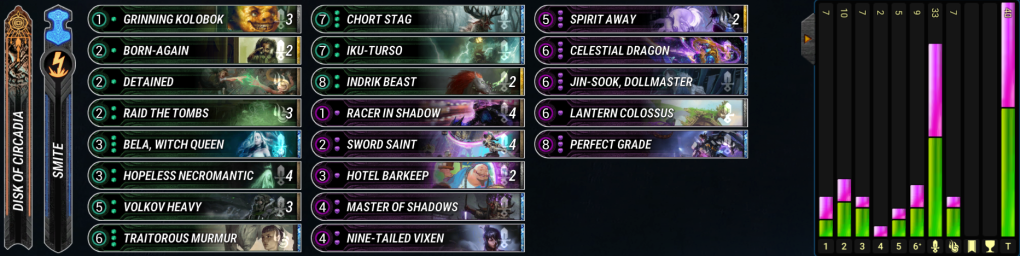
GP Necromantic is the most defensive and flexible of all the necro variants. It doesn’t have the high roll potential of some of the other necro decks, but makes up for it more utility with tools like Racer in Shadow and Sword Saint. Having that utility along with Necromantic makes GP Necromantic a nightmare for any aggressive deck, though every deck should be prepared for it in some capacity. If you don’t hit a necro curve the deck just plays like a midrange deck that aims to burn to 7 or 8 to start dropping bombs.
Though aggro decks are less prevalent now after the recent update, GP did get the new gift of Master of Shadows which can steal games against midrange by itself. GP Necromantic is favored against aggro, goes even against midrange, but can struggle closing the game against control decks if it lets the game go too late. – NKL
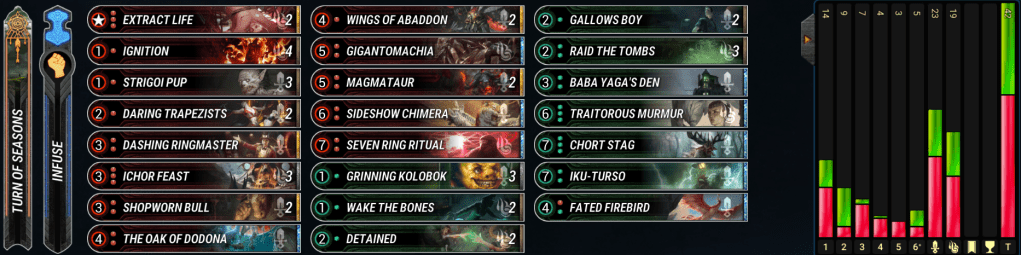
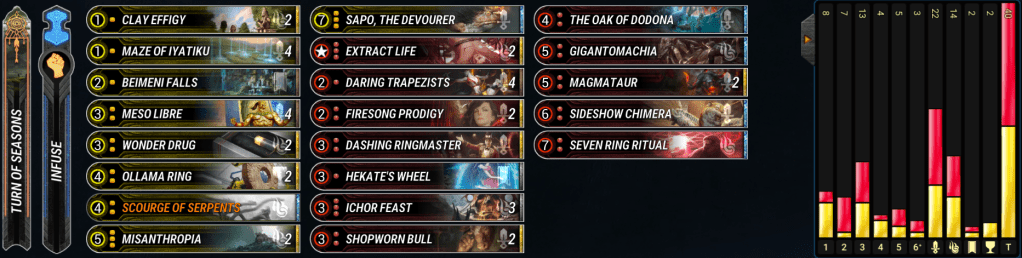
RG Control is one of the weirder decks to play and pilot. It plays the best draw spells in the game in Ichor Feast and Raid the Tombs to have some of the better hand tempo in the game for a Turn of Seasons deck. It’s optimized with having cheap cards, like Strigoi Pup and Ignition to play in combination with those cards. The deck plays for board heavily with defensive spells and rush minions early, so you can get into the late game to gas them out with big Dreni/Green minions. There is also the Ringmaster Seven Ring Ritual combo looming if you can burn up to it to end games against YG and YO control decks. RG has a problem with Necromantic decks with only a few options against it as well as Master of Shadows and opposing Seven Ring Rituals. It’s important to continually fight for board and pressure the opponent so those cards don’t blow you out. – Oneiric
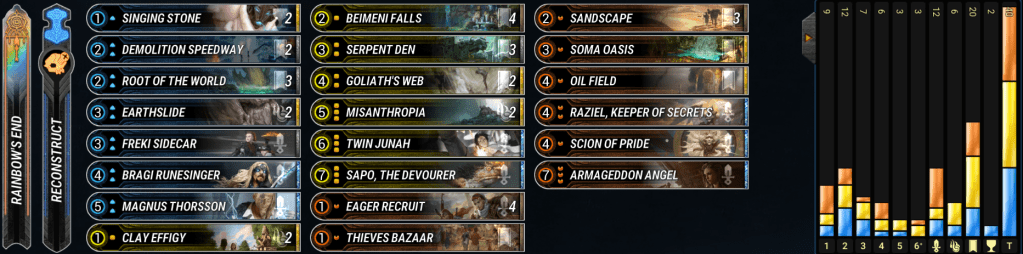
An enchantment based control deck, Angel Loop looks to fill the board with useful enchantments to push into the late game and then cycle their creatures using Root of the World for advantage. The early game of Angel Loop provides the more varied aspects but due to the Beimeni Falls it has become a strong late game contender after it stabilizes versus aggro or midrange decks. It can go about even with the RO Aggros and Midranges as well as even with YO. It still struggles versus extremely fast decks or anything that provides a lot of overrun as the snakes do most of the blocking and against YG control, as their ability to burst from hand and apply pressure seems to be a bit more elevated than loop. It may see less play on ladder due to the 3 color combination and the ease of misplays, it’s a deck that takes practice to pilot consistently. – Ejecty
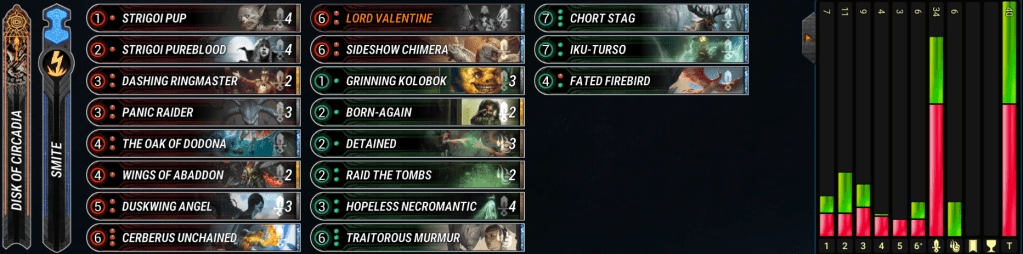
RG Necromantic is the most unique variant of Necro yet. Using the solid shell of the necro package with Strigoi/Red’s pressure tools RG Necro comes out with a tempo abomination. The clear tempo combo is Hopeless Necromantic on 3 into Wings of Abbadon on 4, sac the Necro and attack face or trade with a minion with Immortal Wings. It helps that Necro defaults to Smite already so pressure is abundant from the start with their power. The deck still plays fattys at the end of the game like other Necro decks. Even with strong tempo options, RG Necro struggles with any deck that plays boneyard hate like any other necro. Still, RG Necro should beat abundantly greedy decks and has a good matchup against Aztec/YO. – Oneiric
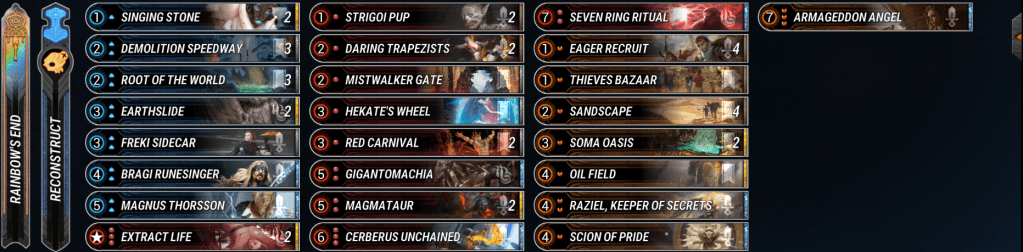
Ahhh the big bad of the previous metagame. Even with the nerfs to the deck I still like it’s position in the metagame. The decks gameplay is relatively simple hit face and put rush minions onto enchantments for stronger minions/more damage. New tools like Magmataur are needed to replace slots Fire Eater left behind and a spicy option in Mani, Queen of Tides. The deck still has a bad matchup against GP Necro, but still decks that use minions as blockers should be abused by Demolition Speedway. – Oneiric
Yellow Red control takes the traditional Yellow control package and augments it with powerful Red removal, rush minions, and draw power. Ollama ring is the core for this deck by improving minion trades, especially with Trapezist and Meso Libre, while also buffing the big finishers such as Seven Ring Ritual and Chimera. Magmataur, Misanthropia, and Gigantomachia are some of the most powerful board wipes in the game and help reset tempo and open the way for your buffed attackers. Most control decks need time to really ramp up before applying pressure to the opponent, but a good hand with YR can start really building tempo by turn 4 thanks to ollama ring. Most aggressive decks are easily dealt with due to the life gain and board wipes, while trapezists and ringmaster allow the deck to rush down and finish other control decks. Overall the deck provides a ton of mid game pressure with one of the strongest combo finishers using 7RR + Ringmaster + Ollama rings, but falls short in terms of very late game value compared to other control decks. – largenuggets
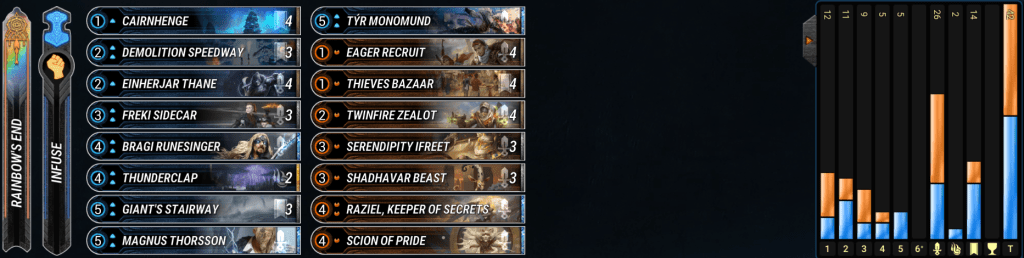
Frenzy aggro is fast pressure deck that abuses twinfire into enchantments to take off huge points of damage early and often. Serendipity Ifreet and Raziel can provide free draws with rainbow passive, while also just being big minions to pressure. Frenzy Aggro can be vulnerable to board clears and cheap removal like Ignition or Trapezist so you must put twinfires into Cairnhenge if you read your opponent may have those cards early. Mostly Frenzy is a good deck that has clear weakness and clear strengths. Crazy openers and Freki Sidecar lethals are a norm for this deck you just gotta find them. – Oneiric
Valks have been steady in the metagame for a long time. This version opts to use Rainbow’s End and Impel to move around our big overstated minions. Mono-Blue dips us into Bridgeway troll so we can have even more free move actions to abuse our best enchantments on board. Valks are still pretty vulnerable to stabilization from Misanthropia and Armageddon Angel which are prominent in the best decks right now. The deck falls short to the other aggro decks in that must use to Freki Sidecar to pressure after board clears, but the archetype is solid enough in the early game that the downside isn’t too bad. – Oneiric
Necro decks utilize the Disk of Circadia discard effect and the Hopeless Necromantic demise effect to cheat out big creatures much earlier than usual. Blue is a pretty common choice for necro decks, featuring many oversized fatties and some powerful tempo cards such as Magnus and Bragi. Blackened Jotun and Volcanic Risi are both uncommon cards with very powerful bodies and effects. Freki Sidecar gives those fatties rush, even if they are summoned from necro, enabling explosive, high-tempo plays. Junkyard Valhalla is a controversial card because it is very slow, but having a backup necro is very powerful and it can be devastating for the opponent when played at the right time. BG Necro has the advantage of being pretty cheap to build and easier to pilot than most other necro decks. Unfortunately, Blue is less powerful right now than usual for a few reasons including not having an answer for Master of Shadows. Not having enough hard removal and poor aoe above 2 damage really hurts their ability to compete with top decks. Furthermore, experienced players often build their decks with necro in mind, and have strategies to minimize or fully counter the necro effect. Overall BG necro is an easy to build and learn necro deck which makes up for lack of tools with raw power and heavy tempo tools. – largenuggets
Wildcard:
These aren’t decks we missed out on the tier list or decks that are necessarily competitive. Just fun/conceptual decks that we like.
Man this project was fun, but honestly hard at times. It took away most of my free time these past few days, even then Mythgard is a game that’s worth quality content. I know I missed a good chunk of decks that could be/is good in the meta, but time is a constraint and I wanted to get this out before Winter Wonderbrawl on the December 15th. We’ll work on things like formatting and stuff to make these tier list better. Please give any suggestions on what you may want to see, whether it’s formatting wise or decks that should make the tier list in the comment section.
SHOUT OUTS!
Big ups to NKL, largenuggets, erobert, and Ejecty for the help with various testing, writing and meta talk. I couldn’t have done this project without them.







 steadyCuration
